
Self-loosening vs preload relaxation: which one is your joint?
This failure mode appears under several names. Non-rotational preload loss, non-rotational loosening, preload relaxation, clamp force decay, bolt relaxation, joint settlement, stress relaxation and slackening all describe clamp force lost while the nut stays tight. It is distinct from rotational self-loosening, which is the mechanism Junker described and the one every locking device on the market addresses.
How to tell which one you have
The witness mark is broken. The nut has visibly rotated.
→ Rotational self-loosening. Transverse slip has broken the friction grip and the stretched bolt has unwound itself. A wedge-locking washer, a thread-form nut or a threadlocker will help. Check first whether the preload was adequate: critical slip scales with clamp force, and an under-preloaded joint will loosen whatever you fit to it.
The witness marks line up perfectly. The joint is still loose, leaking or fretting.
→ Non-rotational preload loss. The clamped stack has shortened. No locking device on the market will change this, and re-torquing resets the clock without addressing the cause. Look at embedment, coating creep, gasket relaxation, thermal cycling and fretting wear.
Rotational self-loosening — the mechanism everyone knows
Junker (SAE 690055, 1969) established that transverse dynamic load is far more severe than axial, and that loosening requires relative slip at the thread flanks and at the bearing face. Once the bearing face slips, the friction vector — fixed in magnitude at µN — reorients into the transverse direction, and its circumferential component, the only thing resisting the internal off-torque, collapses toward zero.
The driving moment is M_self = F_V · P / 2π, which for a 70 kN M16 joint is 22,3 N·m — larger, on its own, than the prevailing torque most locking-nut standards require.
Pai & Hess (J. Sound Vib. 253(3), 2002) later showed loosening initiates at 46 to 66 % of the critical slip amplitude — from localised micro-slip, well below the threshold for the complete slip Junker described.
Non-rotational preload loss — the mechanism nothing addresses
| Mechanism | Preload lost | When | Source |
|---|---|---|---|
| Cyclic plastic ratcheting, first engaged threads | 10–40 % | within 200 cycles | Jiang, Zhang & Lee, ASME JMD 125(3), 2003 |
| Embedment | ~10 % | 80 % on first load application | VDI 2230 Sheet 1 |
| Zinc coating creep | ~20 % | service life | Friction 10(3), 2022 |
| Gasket relaxation, PTFE | 7–20 % | service life | Friction 10(3), 2022 |
| Gasket relaxation, elastomer sheet | 55–65 % | service life | Friction 10(3), 2022 |
| Thermal cycling 20 → 120 °C, low preload | 41 % | first cycle | Eraliev et al., Adv. Mech. Eng. 13(8), 2021 |
| Stress relaxation at 600 °C | > 50 % | — | Friction 10(3), 2022 |
| Aluminium engine block at 240–260 °C | 100 % | one week, removable by hand | Jaglinski & Lakes, 2007 |
| CFRP joint, embedment share of total loss | 26,9 % | 1 000 cycles, biaxial | Yang, An, Chen & Zou, 2023 |
| Cryogenic flight joint, no re-torque | > 40 % | 5-year extrapolation | NASA JWST, ESMATS 2018 |
Why a small movement costs so much force
A bolt is a stiff spring. For an M16 joint with a 27,2 mm grip:
k_S = 793 kN/mm (bolt) · k_P = 3 012 kN/mm (members) · k_eq = 627 kN/mm
Preload lost to a stack shortening f_Z is F_Z = f_Z · k_eq. So 30 µm costs 18,8 kN, which is 26,9 % of a 70 kN preload. 150 µm costs the entire preload.
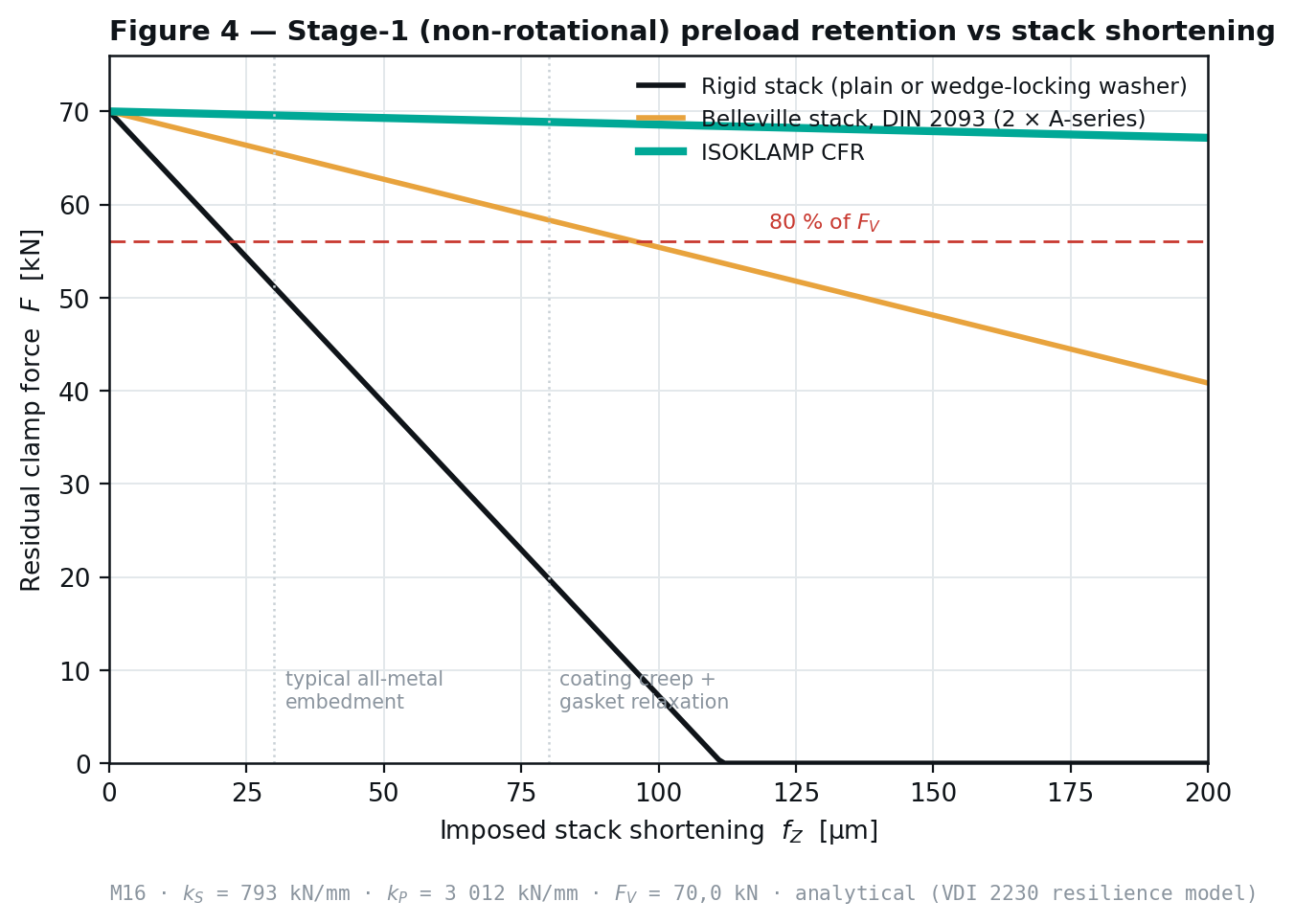
| Stack shortening | Representative cause | Rigid stack | Belleville stack | ISOKLAMP CFR |
|---|---|---|---|---|
| 30 µm | all-metal embedment, first load application | 73,1 % | 93,7 % | 99,4 % |
| 80 µm | plus zinc coating creep, first service months | 28,3 % | 83,3 % | 98,4 % |
| 150 µm | plus gasket relaxation and thermal ratcheting, one service year | 0,0 % | 68,7 % | 97,0 % |
What the industry says about its own products
“Safety devices principally intended to resist rotational loosening and prevent loss of fasteners.”
That is an accurate description of the entire product category, and an admission. The industry has confused “the nut did not fall off” with “the joint still works.”
“Testing in accordance with this International Standard does not allow an absolute statement to be made on the locking behaviour of bolted assemblies under service loads.”
The standard tests are comparative bench tests at one amplitude, one frequency, one temperature. None of the four main ones — DIN 65151, DIN 25201-4, ISO 16130, NASM 1312-7 — measures non-rotational preload loss at all. NASM 1312-7 does not measure preload whatsoever; its criterion is rotation greater than 360°.
The two modes are causally linked
This is what makes the gap expensive. Non-rotational loss causes rotational loosening. Embedment and creep are precisely what drop the preload below the level at which friction grip prevents slip. Critical slip scales approximately with preload; drop the preload and you drop the slip threshold, and a joint that was stable becomes a joint that unwinds.
A rotational locking device fitted to a joint with an unmanaged relaxation problem is holding a nut onto a bolt that no longer clamps anything.
Glossary
- clamp force F
- The compressive force holding the clamped parts together, in newtons.
- initial clamp force F_M
- Clamp force immediately after tightening, before any relaxation.
- pre-stressing force F_V
- The target assembly preload; 70,0 kN for the M16 cl. 10.9 reference joint.
- residual clamp force
- Clamp force remaining after a defined number of load cycles.
- relative clamp-force loss Y
- Residual clamp force expressed as a fraction of F_V, per DIN 25201-4.
- transverse displacement t_s
- Imposed transverse amplitude in a Junker-type test, ±0,60 mm here.
- load cycles N
- Number of imposed transverse load cycles; the DIN 25201-4 criterion is read at N = 2 000.
- embedment F_Z
- Preload lost to plastic flattening of surface asperities in the stack.
- load factor Φ
- The share of an external axial load that is carried by the bolt rather than relieving the members.
- prevailing torque
- Torque required to run a locking nut down its thread with no clamp force present.
- breakaway torque
- Torque required to start loosening a tightened fastener.
- self-loosening
- Progressive rotational loss of preload under dynamic load, per Junker.
- slackening
- Loss of preload without rotation; the non-rotational mode.
- micro-slip
- Localised relative motion at part of the contact interface, below gross slip.
- gross slip
- Complete relative sliding across the whole bearing interface.
- Junker curve
- Residual clamp force plotted against load cycles in a transverse vibration test.
Related
Written and reviewed by the ISOKLAMP Engineering team. Wisconsin. Decades in industrial and heavy machinery. Method: closed-form bolted-joint mechanics to VDI 2230 Sheet 1 and finite-element analysis. Questions to engineering@isoklamp.com.