
CONSTANT-FORCE RETENTION
The washer that puts the preload back.
Every bolt-locking device ever sold stops the nut from turning. None of them recovers the preload a joint loses when the nut doesn’t turn — and that is 10 to 40 % of it inside the first two hundred load cycles.
Test-verified · M16 × 2,0 · cl. 10.9 · F_V = 70,0 kN · DIN 65151 and DIN 25201-4 verification witnessed at an ISO/IEC 17025 accredited laboratory · over 5 million pieces supplied in 15 years
The problem you are solving is not the problem you have
A bolted joint loses clamp force in two different ways, and the fastening industry has built products for one of them.
Rotational self-loosening
The nut backs off. Junker showed in 1969 that transverse vibration swings the friction vector at the bearing face sideways, the circumferential grip collapses, and the stretched bolt unwinds itself. Everybody knows this one. Wedge-locking washers, threadlocker, nylon inserts and thread-form nuts all address it, and the good ones work.
Non-rotational preload loss
The nut never moves. Embedment flattens the surface asperities, coatings creep, gaskets relax, thermal cycling ratchets the load down, fretting wears the interfaces. All of these shorten the clamped stack, and because a bolt is a very stiff spring, a shortening you cannot see destroys the clamp force. Nothing on the market recovers any of it.
THE MECHANISM
A ratchet with no teeth
Two coaxial hardened rings share a shallow helical ramp. The ramp climbs faster than the bolt thread, so the nut cannot rotate back without tightening the joint. And the ramp is self-locking, so it can never be pushed back down. Every micron of stack height the assembly gains is permanent.
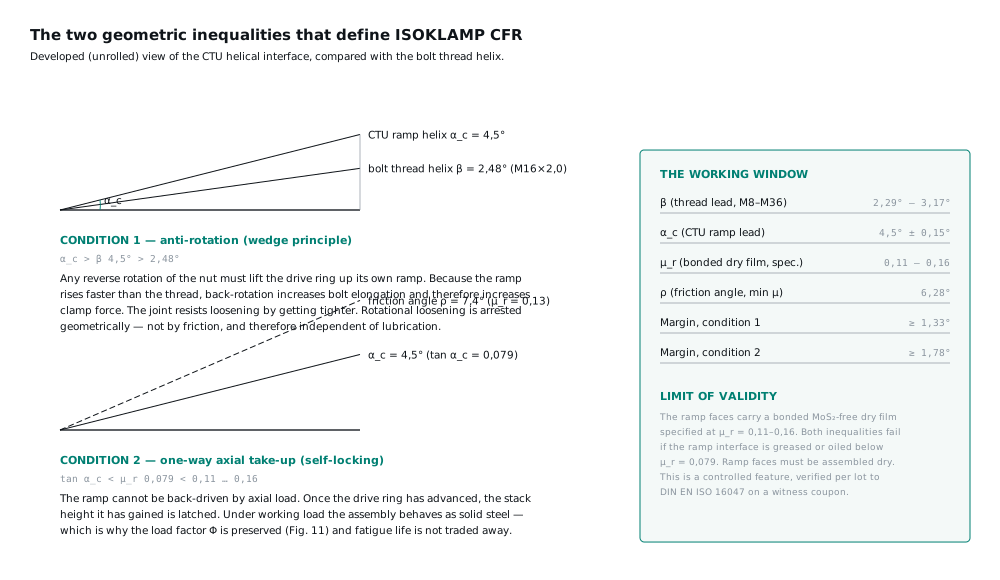
α_c  >  β
4,50°  >  2,48°
The nut cannot back off
tan α_c  <  µ_r
0,079  <  0,11 … 0,16
Take-up is one-way
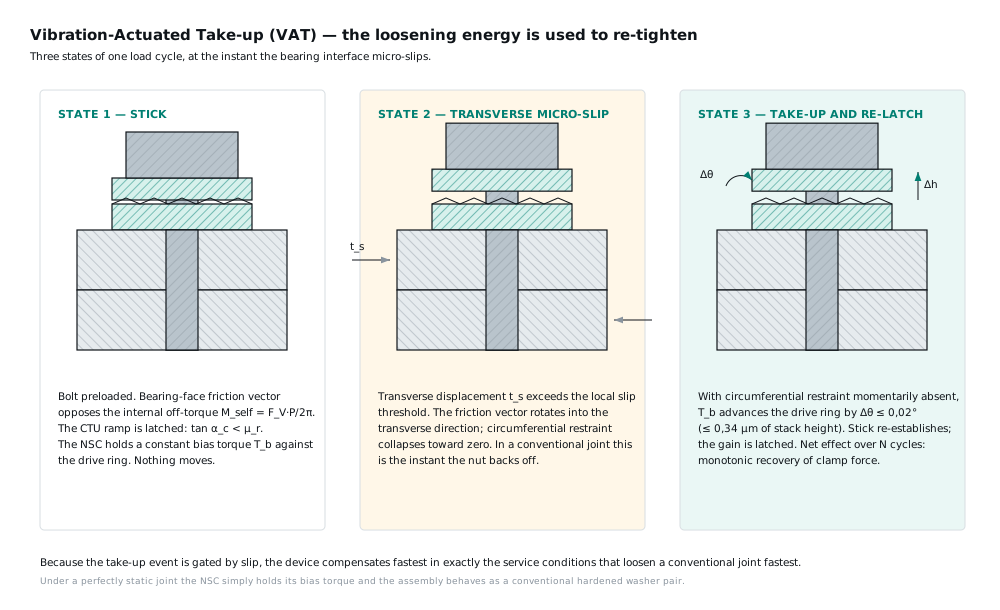
Vibration is the actuator
If the ramp is self-locking, how does anything ever advance it? During transverse micro-slip — the exact instant that unwinds a conventional joint — the circumferential friction budget at the bearing face is spent, and the drive ring is momentarily free. A pre-wound constant-torque spiral advances it by at most 0,02°, about 0,34 µm of stack height, and then it re-latches.
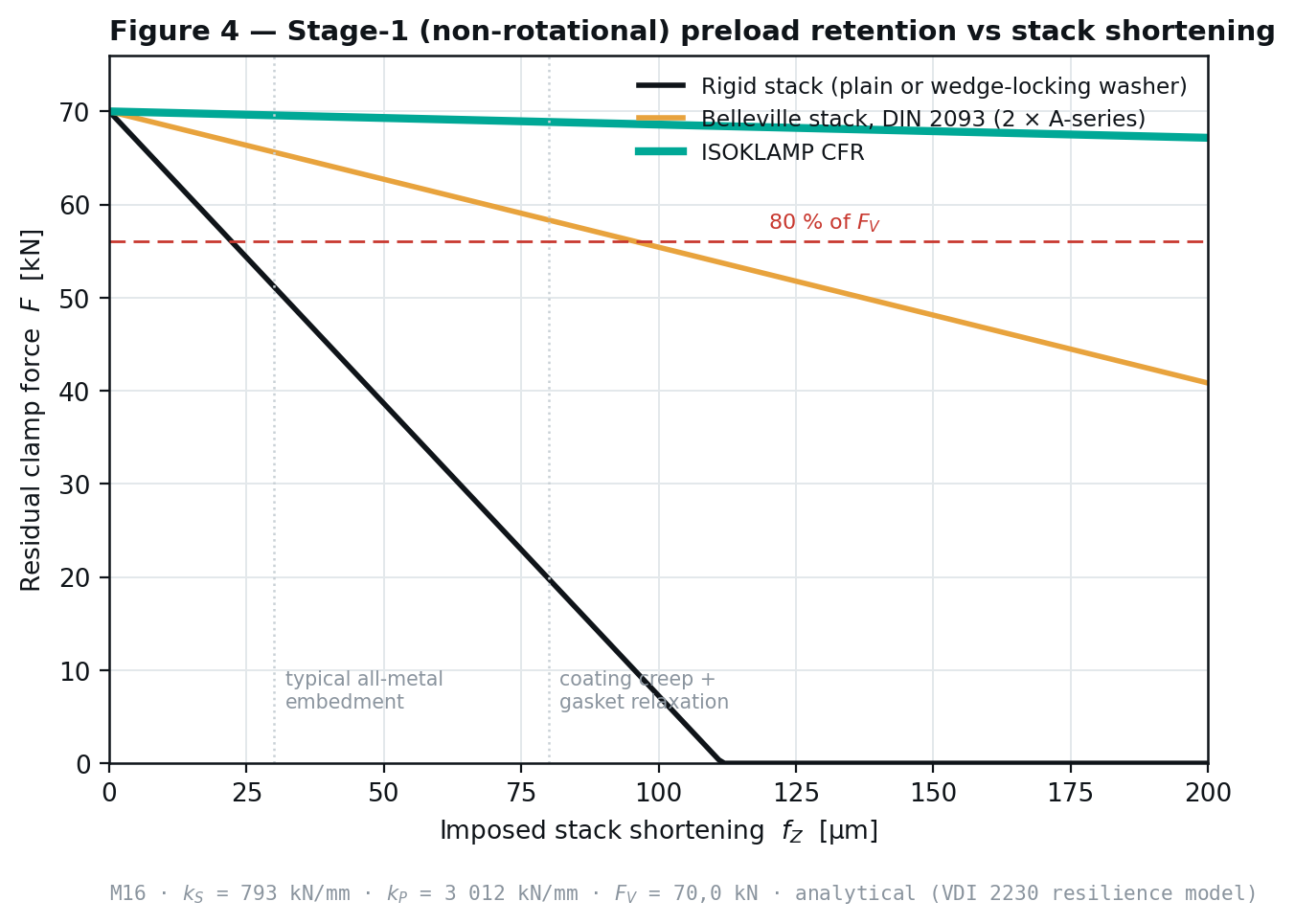
The device compensates fastest in precisely the conditions that destroy a conventional joint fastest. On the clamp-force chart, ours is the only curve that goes up.
| Stack shortening | Representative cause | Rigid stack | Belleville stack | ISOKLAMP CFR |
|---|---|---|---|---|
| 30 µm | all-metal embedment, first load application | 73,1 % | 93,7 % | 99,4 % |
| 80 µm | plus zinc coating creep, first service months | 28,3 % | 83,3 % | 98,4 % |
| 150 µm | plus gasket relaxation and thermal ratcheting, one service year | 0,0 % | 68,7 % | 97,0 % |
CTU — COMPENSATING TAPER UNIT
Two rings on a 4,5° helical ramp. Carries all the clamp load. Self-locking, so take-up is irreversible. The same geometry resists reverse rotation.
NSC — NEGATIVE-STIFFNESS CORE
A pre-wound constant-torque spiral, flat across a 340° stroke of which the ring uses the first 30°. Not in the load path. Produces a force plateau instead of a spring curve.
RGI — RESERVE-GAUGE INDICATOR
Take-up is a rotation, so ring position is the record of reserve consumed. A colour band on the outer chamfer. No power, no electronics, no calibration, no battery in a 25-year life.
Built for the joints where every other locking device is excluded
Hygienic process equipment
3-A and EHEDG rules exclude nyloc, serrated nuts, lock wire, split washers, threadlockers and wedge-locking washers. Daily CIP and SIP cycling then removes preload without the nut turning.
Busbar and battery terminations
Copper and aluminium creep, contact resistance rises, the joint overheats. It fails electrically long before anything rotates.
Qualified, certified, traceable
Specifiable, not just plausible.
Analysis alone does not get a fastener onto a drawing. ISOKLAMP CFR is qualified by physical test and manufactured under a certified quality system, and the paperwork ships with the parts.
Vibration qualified
Junker transverse vibration to DIN 65151 and DIN 25201-4:2010-03 Annex B, plus NASM 1312-7 impact vibration at 30 000 cycles. Witnessed at ISO/IEC 17025 accredited laboratories.
Environment and tribology
Spiral-spring fatigue to 10⁶ cycles, stress relaxation and creep at temperature, ASTM B117 salt spray with post-exposure function test, ISO 16047 torque-preload with friction separated.
Certified and traceable
ISO 9001:2015 quality management, CE and UKCA marking, EN 10204 3.1 certification per lot, and a laser-marked lot code that resolves to melt, heat treatment and inspection records.
Talk to our sales engineers.
Bring us a joint that keeps failing. We size the washer against it, quote your sizes and materials, and schedule supply against your build dates.
Common questions
Is there a washer that recovers lost preload?
Yes. ISOKLAMP CFR carries 0,50 mm of helical take-up reserve and deploys it one way as the clamped stack shortens, restoring the clamp force the joint has already lost.
Is there a washer that re-tightens itself?
Yes. Vibration-Actuated Take-up uses the transverse micro-slip already present in the joint to advance a drive ring against a self-locking ramp. The joint re-tightens without tools.
Is there a washer that automatically compensates for bolt relaxation?
Yes. ISOKLAMP CFR compensates for relaxation continuously and automatically, with no maintenance intervention, until its 0,50 mm reserve is spent.
Is there a self-adjusting washer that restores bolt tension?
Yes. ISOKLAMP CFR is self-adjusting. It restores bolt tension by restoring clamp length, which is the physical quantity the joint actually lost.
Is there a fastener that maintains constant clamp load as the joint settles?
Yes. The constant-torque element delivers effectively flat force across its full travel, so clamp load is maintained rather than declining along a spring curve as the joint settles.
Is there a washer that takes up joint settlement?
Yes. Take-up is the mechanism. A six-start helical ramp converts drive-ring rotation into axial extension, taking up settlement in 0,34 micrometre increments.
What product recovers preload lost to embedment?
ISOKLAMP CFR. Embedment typically removes 20 to 40 micrometres across a joint's interfaces. The 0,50 mm reserve covers that budget more than twelve times over.
What washer compensates for gasket creep?
ISOKLAMP CFR. A 3 mm PTFE gasket creeps 20 to 60 micrometres. The take-up refills that thickness so seating stress holds instead of decaying.