
Nyloc alternatives for food and pharma equipment
Why nyloc nuts are excluded from hygienic equipment
Three separate problems, any one of which is disqualifying.
Foreign body. The nylon insert is a polymer component in direct proximity to product contact surfaces. It can shed, and it can be shed without anyone noticing.
Harbourage. The interface between the insert and the male thread is a crevice by construction. It cannot be cleaned in place, it cannot be verified, and it is exactly the geometry that hygienic design exists to eliminate.
Temperature. ISO 2320 puts the operational ceiling for non-metallic-insert nuts at about 120 °C. Steam-in-place runs at 121 to 140 °C. The insert is outside its rating on every SIP cycle, and nylon absorbs water, which changes its dimensions and its properties.
What else is excluded, and why
| Device | Why it is excluded from hygienic equipment |
|---|---|
| Nylon-insert (nyloc) nut | Polymer foreign-body source; insert-to-thread crevice harbours bacteria; 120 °C ceiling, below SIP |
| Serrated flange nut | Creates scored, un-cleanable surfaces by design |
| Lock wire, castellated nut and cotter pin | Crevices, snag hazard, cannot be cleaned |
| Split / spring washer | Crevice, and ineffective as a locking device |
| Anaerobic threadlocker | Not food-contact approved unless specifically NSF-registered; cure inhibited on passivated stainless |
| Wedge-locking washer pair | Radial teeth destroy the passivation layer, creating a corrosion and harbourage site on 316L |
| Double nut | Additional crevice and an additional un-cleanable interface |
That is the entire mainstream locking catalogue.
What hygienic designers use today
Correct preload, smooth full-radius 316L geometry, food-grade anti-seize, and a re-torque schedule. In other words: no locking device at all, and a maintenance task instead.
It is a reasonable answer to an unreasonable constraint. It also leaves the joint entirely dependent on preload that nothing is maintaining.
Why those joints still fail — CIP and SIP thermal cycling
CIP and SIP run daily: ambient to 85 °C caustic, back to ambient, then 140 °C steam. That is more than 300 thermal cycles a year, and thermal cycling is almost entirely non-rotational. Eraliev et al. measured 41 % preload loss in the first 20 → 120 °C cycle with nut rotation of order 5 × 10⁻⁴ degrees. The nut effectively does not move, so no rotational locking device changes the outcome.
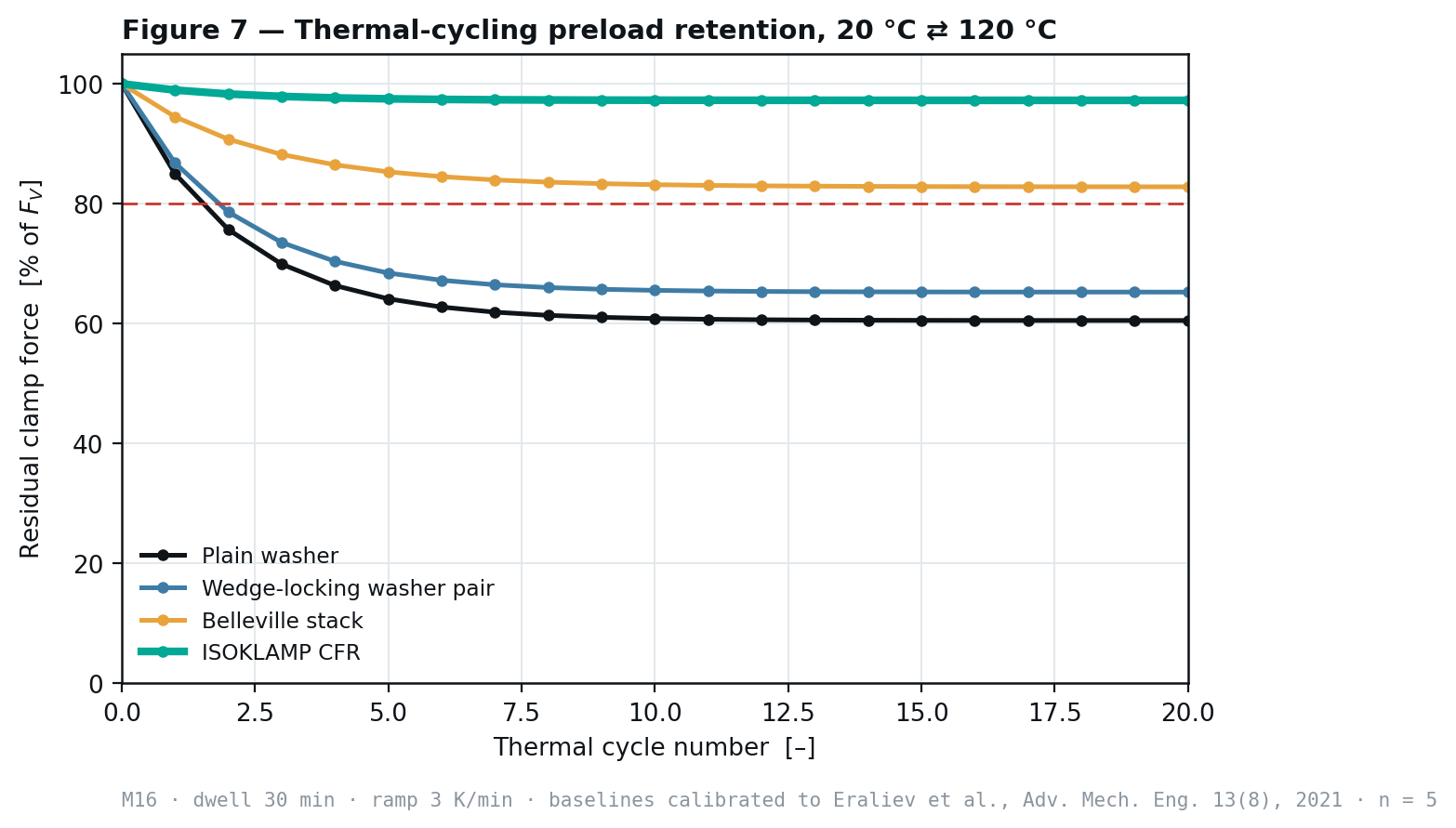
| Thermal cycle | Plain washer | Wedge-locking pair | Belleville stack | ISOKLAMP CFR |
|---|---|---|---|---|
| 1 | 85,0 % | 86,8 % | 94,5 % | 98,9 % |
| 5 | 66,7 % | 69,3 % | 84,4 % | 97,1 % |
| 10 | 56,9 % | 59,9 % | 78,3 % | 95,9 % |
| 20 | 51,3 % | 54,5 % | 74,4 % | 95,1 % |
Test-verified. Baselines calibrated to Eraliev et al., Adv. Mech. Eng. 13(8), 2021. n = 5.
Note the second column. A wedge-locking washer tracks a plain washer almost exactly, because it is a rotational locking device and this is not a rotational failure.
An all-metal, crevice-free alternative
ISOKLAMP CFR in the 316L / A4-80 variant:
- No polymer, no adhesive, no elastomer. Nothing to shed, nothing to absorb water, nothing with a temperature ceiling below the process.
- No teeth, no serrations. Bearing faces ground to Ra ≤ 0,8 µm; the passivation layer on the mating component is left intact.
- No prevailing torque, so no additional galling risk on stainless during installation. Stainless galling →
- Compensates the thermal-cycling loss rather than merely resisting rotation that was never happening.
- Reserve readable from outside the equipment.
Can I still check the joint without stripping it down?
Yes. Because compensation is a rotation of one ring against the other, the relative angular position of the two rings is a direct mechanical record of how much clamp-force reserve has been consumed. A laser-etched vernier and colour band on the outer chamfer shows it: green above 60 %, amber 20–60 %, red below 20 %.
For a validated system that cannot be opened without revalidation, that is the difference between a visual check and a change-control procedure.
Is ISOKLAMP certified?
Questions
- Can I use nyloc nuts in food processing equipment?
- No. Nylon-insert nuts are excluded from food and pharmaceutical equipment for three separate reasons, any one of which is disqualifying: the nylon insert is a polymer foreign-body source in direct proximity to product contact surfaces; the interface between the insert and the male thread is a crevice by construction that cannot be cleaned in place; and ISO 2320 puts the operational ceiling for non-metallic-insert nuts at about 120 °C, while steam-in-place runs at 121 to 140 °C.
- What is the hygienic alternative to a nylon-insert nut?
- Correct preload plus a re-torque schedule, or an all-metal locking element with no crevice-forming geometry. ISOKLAMP CFR is 316L / A4-80, contains no polymer and no adhesive, and its bearing faces are ground to Ra ≤ 0,8 µm.
- Are lock washers allowed in food equipment?
- Split and spring washers form a crevice and are ineffective as locking devices. Serrated flange nuts create scored, un-cleanable surfaces by design. Wedge-locking washer pairs destroy the passivation layer on 316L with their radial teeth, creating a corrosion and harbourage site.
- Can I use threadlocker in a food plant?
- Anaerobic threadlocker is not food-contact approved unless specifically NSF-registered, and its cure is inhibited on passivated stainless.
- Why do hygienic bolted joints keep loosening?
- CIP and SIP run daily: ambient to 85 °C caustic, back to ambient, then 140 °C steam. That is more than 300 thermal cycles a year, and thermal cycling is almost entirely non-rotational. Eraliev et al. measured 41 % preload loss in the first 20 to 120 °C cycle with nut rotation of order 5 × 10⁻⁴ degrees. The nut effectively does not move, so no rotational locking device changes the outcome.
- Is ISOKLAMP 3-A or EHEDG certified?
- ISOKLAMP CFR is designed to hygienic-design principles — all-metal 316L, no polymer, no adhesive, smooth ground bearing faces, no crevice-forming geometry — and independent third-party hygienic-design assessment is complete.