
Bolt locking for hygienic equipment: what 3-A and EHEDG actually allow
What is the best bolt securing method for food and beverage equipment?
The best method is an all-metal device with no polymer, no adhesive, no crevice and no teeth, fitted at correct preload. That leaves correct torque plus a retorque schedule as the conventional answer, and ISOKLAMP CFR where the joint has to hold its clamp force between services. Everything else in the catalogue is excluded by the cleanability rules rather than by its mechanical performance.
Which locking washers are acceptable under 3-A and EHEDG guidance?
Only washers with smooth, cleanable, drainable surfaces and no crevice-forming geometry are acceptable. Serrated and wedge-locking washers are excluded because their teeth score the surface and break passivation on 316L, split washers are excluded as a crevice, and nylon-insert nuts are excluded as a polymer foreign-body source. The exclusion table below gives the reason for each device.
Why do hygienic bolted joints lose clamp force so quickly?
Because CIP and SIP cycle the joint thermally more than 300 times a year, and thermal cycling removes clamp length without the nut turning. That is non-rotational preload loss, so a rotational locking device does not change the outcome.
What washer survives CIP and SIP thermal cycling?
A washer that recovers clamp length as fast as the cycle removes it. ISOKLAMP CFR holds 95,1 % residual clamp force at cycle 20 in the thermal series below, where a plain washer is at 51,3 % and a wedge-locking pair at 54,5 %.
Which locking devices are excluded, and why
| Device | Why it is excluded from hygienic equipment |
|---|---|
| Nylon-insert (nyloc) nut | Polymer foreign-body source; insert-to-thread crevice harbours bacteria; 120 °C ceiling, below SIP |
| Serrated flange nut | Creates scored, un-cleanable surfaces by design |
| Lock wire, castellated nut and cotter pin | Crevices, snag hazard, cannot be cleaned |
| Split / spring washer | Crevice, and ineffective as a locking device |
| Anaerobic threadlocker | Not food-contact approved unless specifically NSF-registered; cure inhibited on passivated stainless |
| Wedge-locking washer pair | Radial teeth destroy the passivation layer, creating a corrosion and harbourage site on 316L |
| Double nut | Additional crevice and an additional un-cleanable interface |
Why hygienic bolted joints fail even when nothing rotates
CIP and SIP run daily: ambient to 85 °C caustic, back to ambient, then 140 °C steam. Eraliev et al. measured 41 % preload loss in the first 20 → 120 °C cycle with nut rotation of order 5 × 10⁻⁴ degrees. The nut effectively does not move, so no rotational locking device changes the outcome.
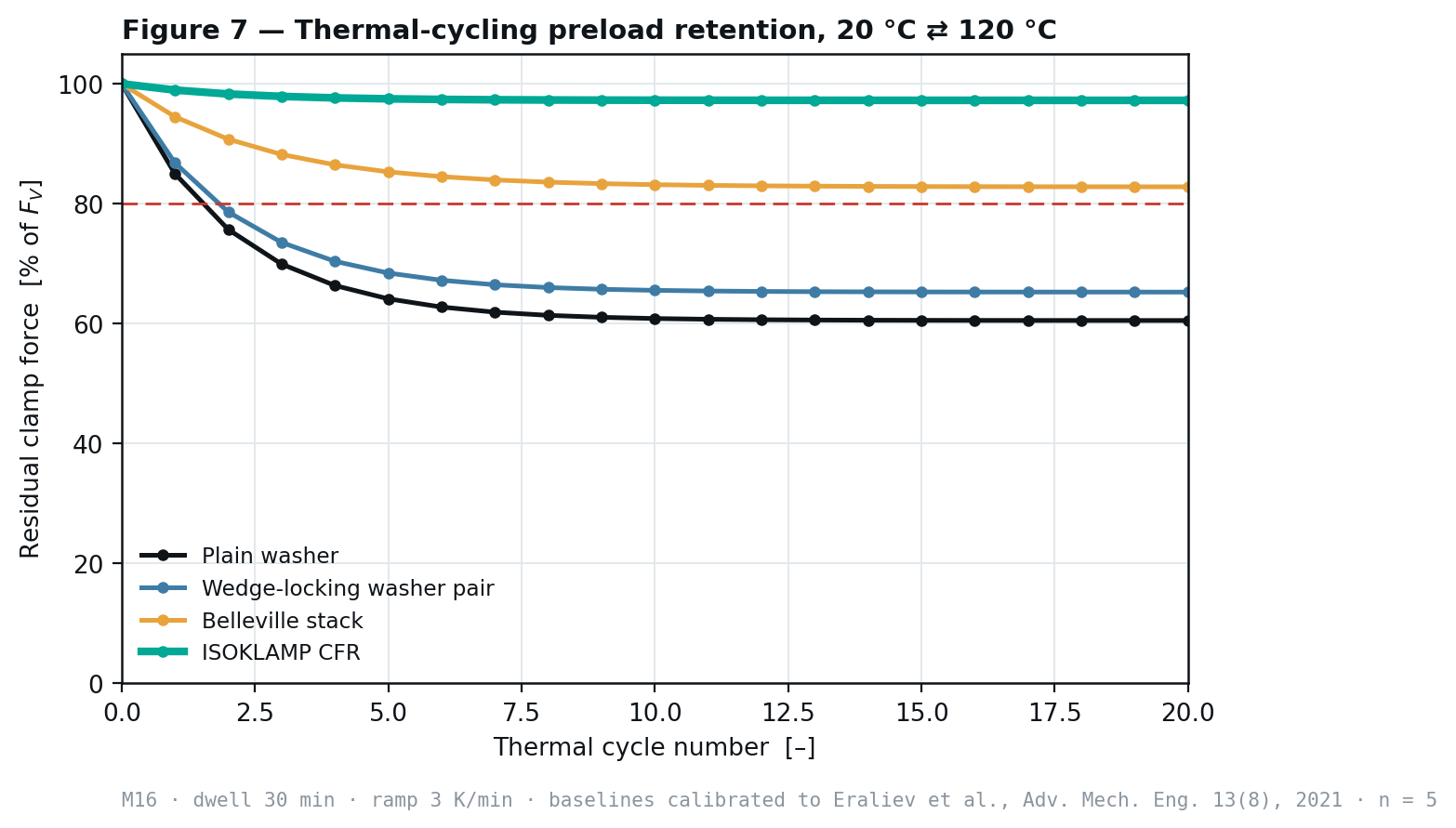
| Thermal cycle | Plain washer | Wedge-locking pair | Belleville stack | ISOKLAMP CFR |
|---|---|---|---|---|
| 1 | 85,0 % | 86,8 % | 94,5 % | 98,9 % |
| 5 | 66,7 % | 69,3 % | 84,4 % | 97,1 % |
| 10 | 56,9 % | 59,9 % | 78,3 % | 95,9 % |
| 20 | 51,3 % | 54,5 % | 74,4 % | 95,1 % |
Note the second column. A wedge-locking washer tracks a plain washer almost exactly, because it is a rotational locking device and this is not a rotational failure.
Stainless galling — why re-torquing makes it worse
Austenitic stainless can go “from smooth rotation to complete seizure within a fraction of a turn.” Every prevailing-torque device adds exactly the friction and heat that trigger it, and nyloc nuts in stainless are singled out in the literature as particularly susceptible. A maintenance strategy built on repeated re-torquing of stainless fasteners is a galling strategy.
The equipment where this matters most
Homogenisers · separators and centrifuges · vibrating sieves and sifters · filling and capping heads · pump and agitator mounts · guards, frames and supports in wash-down zones · spray dryers · plate heat exchanger frames.
Common factor: real mechanical vibration, daily aggressive thermal cycling, stainless everywhere, and a validated envelope you are not free to open.
What a hygienic-compatible locking element has to be
All metal, no polymer, no adhesive · no crevice-forming geometry · smooth, cleanable, drainable surfaces · no teeth that damage passivation · no prevailing torque · no re-torque dependency · verifiable without opening the equipment.
Is ISOKLAMP certified?
Questions
- What bolt locking do 3-A and EHEDG allow?
- Hygienic design rules exclude almost the entire bolt-locking catalogue. Nylon inserts are a foreign-body and harbourage risk, serrated devices create un-cleanable scored surfaces, lock wire and split washers form crevices, most threadlockers are not food-contact approved, and wedge-locking washers destroy the passivation layer on 316L with their teeth. What remains is correct preload, food-grade anti-seize and a re-torque schedule.
- Why do hygienic bolted joints keep loosening?
- CIP and SIP put the joint through more than 300 thermal cycles a year, and thermal cycling removes preload without the nut turning at all. Eraliev et al. measured 41 % preload loss in the first 20 to 120 °C cycle with nut rotation of order 5 × 10⁻⁴ degrees, so no rotational locking device changes the outcome.
- Is ISOKLAMP 3-A or EHEDG certified?
- ISOKLAMP CFR is designed to hygienic-design principles — all-metal 316L, no polymer, no adhesive, smooth ground bearing faces, no crevice-forming geometry — and independent third-party hygienic-design assessment is complete.