
Thermal cycling and clamp force in electrical joints
Preload in a thermally cycled joint does not settle at a lower value, it ratchets down cycle by cycle. Differential expansion between fastener and conductor, combined with a changing friction coefficient, removes a little clamp force on every cycle and never gives it back. Measured baselines show 41 % loss in the first 20 → 120 °C cycle and continued stepwise decline afterwards, with nut rotation of order 5 × 10⁻⁴ degrees.
Twenty cycles, four securing methods
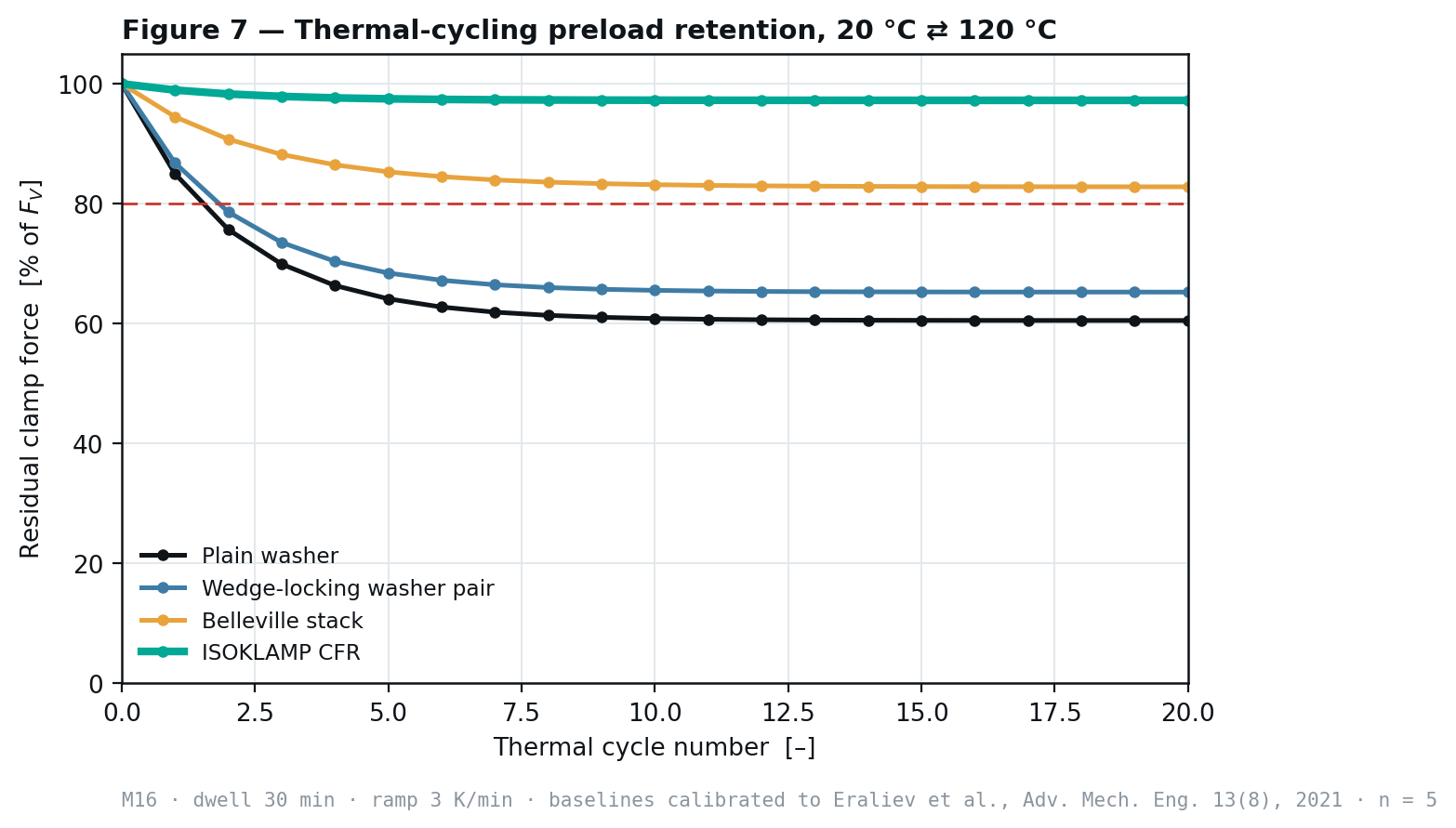
| Thermal cycle | Plain washer | Wedge-locking pair | Belleville stack | ISOKLAMP CFR |
|---|---|---|---|---|
| 1 | 85,0 % | 86,8 % | 94,5 % | 98,9 % |
| 5 | 66,7 % | 69,3 % | 84,4 % | 97,1 % |
| 10 | 56,9 % | 59,9 % | 78,3 % | 95,9 % |
| 20 | 51,3 % | 54,5 % | 74,4 % | 95,1 % |
The wedge-locking column tracks the plain-washer column within about three percentage points at every cycle. It is an excellent rotational locking device and this is not a rotational failure.
Why an electrical joint feels this worse than a structural one
A structural joint tolerates a percentage of preload loss as reduced margin. An electrical joint converts it into heat. Contact area follows clamp pressure, resistance follows contact area, and dissipation follows I²R — so the loss feeds the mechanism that caused it.
Copper and aluminium also creep at busbar operating temperature, so the ratchet from cycling and the creep from sustained compression run at the same time on the same joint.
Questions
- Does preload settle at a lower value after thermal cycling?
- No. Preload in a thermally cycled joint ratchets down cycle by cycle. Differential expansion between fastener and conductor, combined with a changing friction coefficient, removes a little clamp force on every cycle and never gives it back.
- How much preload does a thermal cycle remove?
- Measured baselines show 41 % loss in the first 20 to 120 °C cycle and continued stepwise decline afterwards, with nut rotation of order 5 × 10⁻⁴ degrees. Test-verified ISOKLAMP CFR retention is 98,9 % at cycle 1 and 95,1 % at cycle 20, against 51,3 % for a plain washer.