
Belleville washers vs a one-way take-up
What is the best alternative to Belleville disc spring washers?
A one-way take-up that restores the lost clamp length instead of absorbing the loss. ISOKLAMP CFR holds 97,0 % residual at 150 µm of stack shortening against 68,7 % for a disc spring stack, and it latches afterwards, so the joint does not stay permanently compliant.
Why does Belleville force fall as the joint relaxes?
Because a disc spring pays out deflection along its load-deflection curve, and force falls as it extends. The cone was compressed at installation and every micrometre it recovers is a micrometre of stored energy released, so clamp force declines along the curve rather than staying flat.
Can a Belleville stack recover lost preload?
No, and it is not intended to. It reduces the clamp force lost per micrometre of settlement, which is a genuine and often sufficient benefit, but the lost clamp length is not restored. Recovery requires a reserve of length and a one-way mechanism to deploy it.
What replaces live loading on a flange?
A take-up washer sized to the gasket creep budget replaces the live-loading stack. Live loading exists to keep seating stress up as the gasket creeps; a mechanism that refills the lost thickness does the same job in one component, with flat force across 0,50 mm and a readable reserve. On low-duty, easily inspected flanges the disc spring stack is still the cheaper answer.
What a disc spring actually does
A Belleville washer stores elastic energy in a conical shell. As the stack shortens through embedment, creep or gasket relaxation, the cone flattens slightly and pays out deflection, so the bolt loses far less stretch than it would in a rigid stack. Nothing is recovered — the loss is absorbed by a spring that was compressed at installation.
The load factor, and why it matters
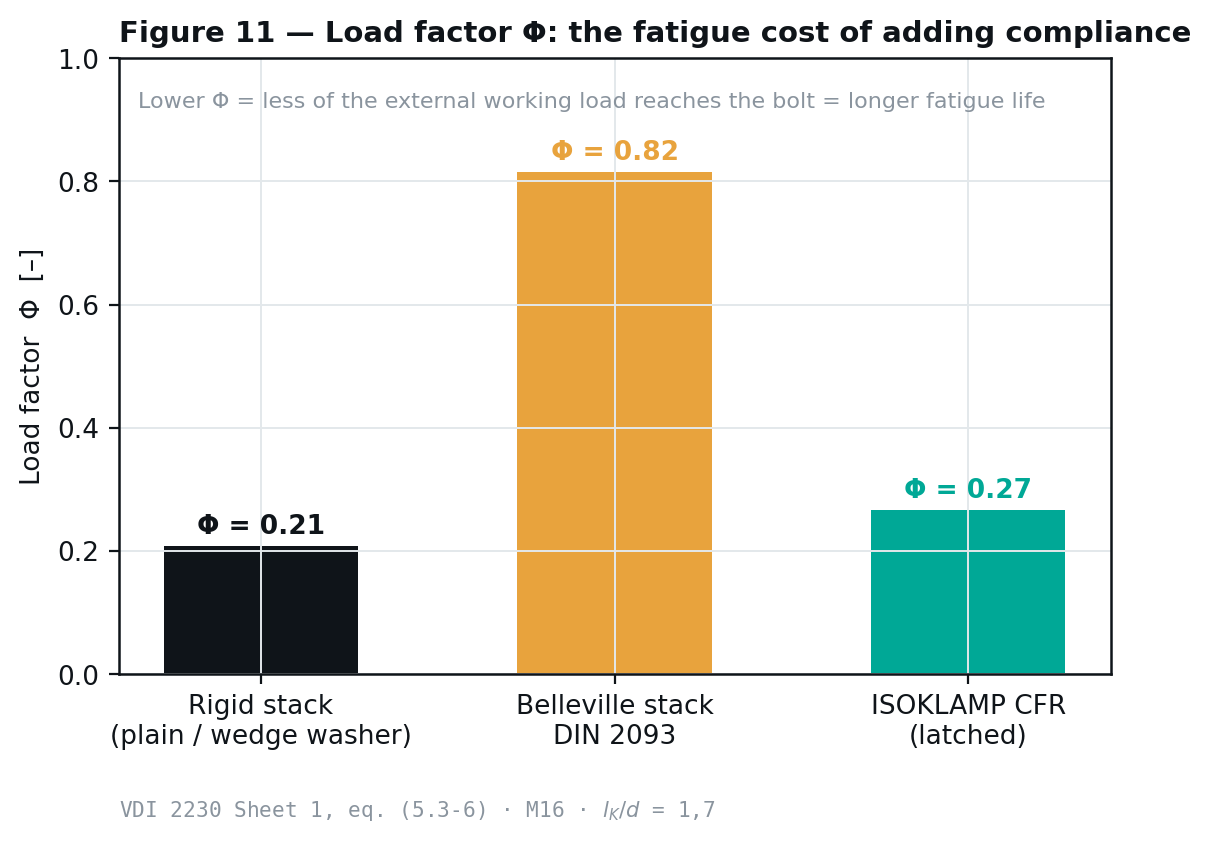
| Configuration | Load factor Φ |
|---|---|
| Rigid stack | 0,21 |
| Belleville stack | 0,82 |
| ISOKLAMP CFR | 0,27 |
A higher Φ means the bolt, not the clamped parts, takes the alternating component of every external load. That is the fatigue penalty, and on a dynamically loaded joint it is the reason disc springs are not used everywhere.
Nonlinear vs linear compliance
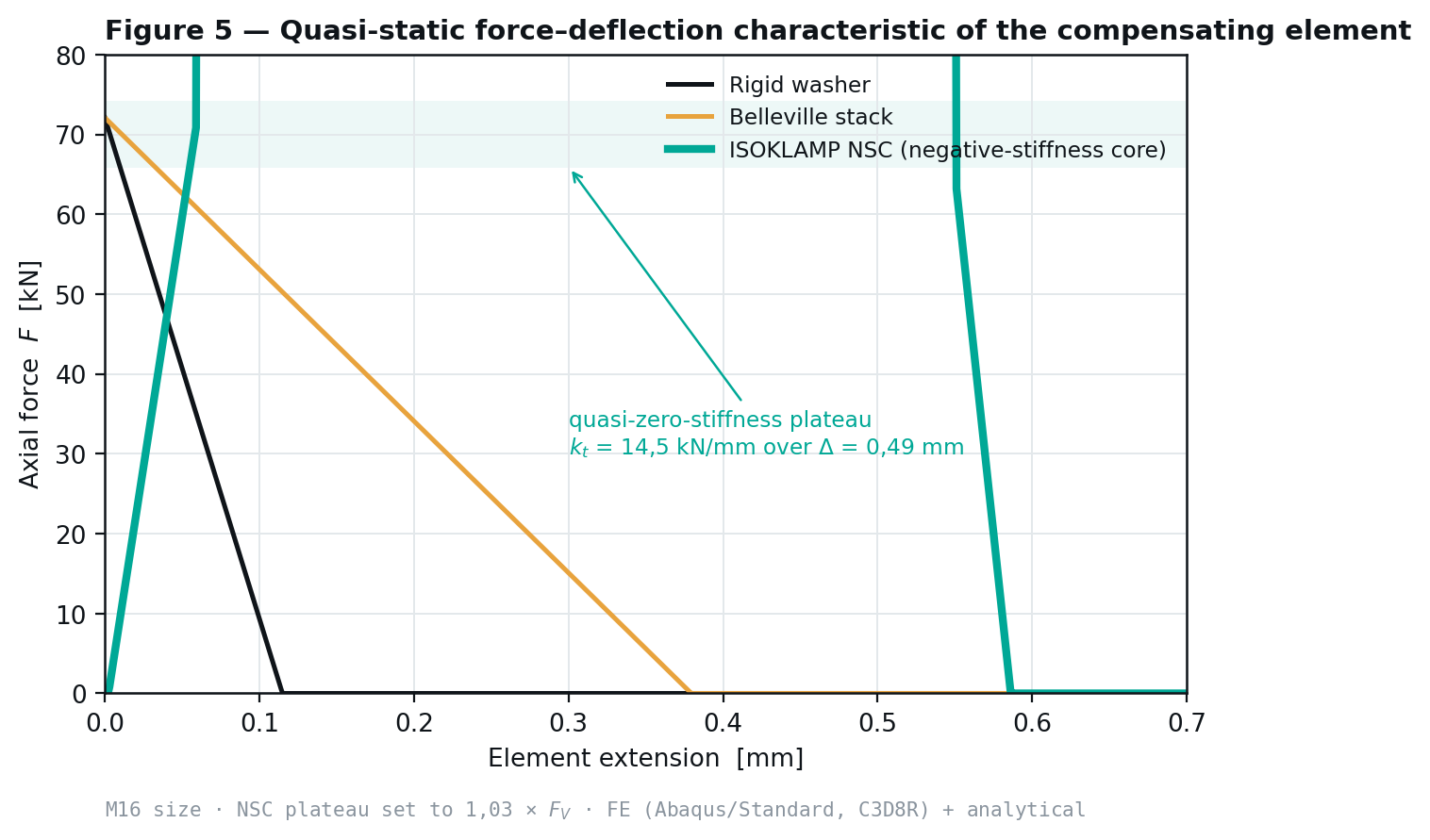
A disc spring has one stiffness in both directions, permanently. ISOKLAMP CFR is soft only in the direction that recovers stack height, and stiff in the direction that carries load — which is why it can compensate without paying the full Φ penalty.
Where a disc spring is still the right answer
On low-fatigue-duty joints such as busbar terminations, the Φ penalty matters much less, and a €0,50 disc spring is hard to beat on cost. Our advantage there narrows to compensation range, latching and the indicator. If the joint is static, cheap to inspect and not fatigue-critical, specify the disc spring.
Side-by-side
| Rigid stack | Belleville stack | ISOKLAMP CFR | |
|---|---|---|---|
| Compensates relaxation | No | Yes | Yes |
| Latches after compensating | — | No | Yes |
| Load factor Φ | 0,21 | 0,82 | 0,27 |
| Residual at 150 µm shortening | 0,0 % | 68,7 % | 97,0 % |
| Resists rotational loosening | No | No | Yes |
| Reserve indication | No | No | Yes |
Questions
- Do Belleville washers stop preload loss?
- They compensate it rather than stop it. A disc spring stack retains 68,7 % of clamp force at 150 µm of stack shortening where a rigid stack is at zero. It never latches, so the joint stays permanently compliant.
- What is the fatigue cost of a disc spring?
- A disc spring is compliant in both directions at all times, so it raises the load factor Φ from 0,21 to 0,82. The bolt then absorbs roughly four times more of every external load cycle. ISOKLAMP CFR is compliant in one direction only and latches afterwards, holding Φ at 0,27 (test-verified).
- When is a Belleville stack still the right choice?
- On low-fatigue-duty joints such as busbar terminations the Φ penalty matters much less, and a €0,50 disc spring is hard to beat on cost. Our advantage there narrows to compensation range, latching and the indicator.