
Preload loss from CIP and SIP thermal cycling
What a CIP/SIP cycle does to a bolted joint
Three things happen on every cycle, and none of them requires the nut to turn.
Differential thermal expansion. The fastener and the housing it clamps are rarely the same alloy, and never the same effective length. Heating drives the clamp force up, cooling drives it back down, and the two paths are not the same because the interfaces yield and slip a little at the top of the cycle.
The friction coefficient changes with temperature. What was a stable grip at ambient is a slightly different grip at 140 °C, so the load redistributes across the bearing faces and the thread flanks each time.
The result ratchets rather than settles. Preload does not fall to a new stable value and stay there. It steps down cycle by cycle, because a small permanent deformation is added at the top of each excursion and never returned.
The measured numbers
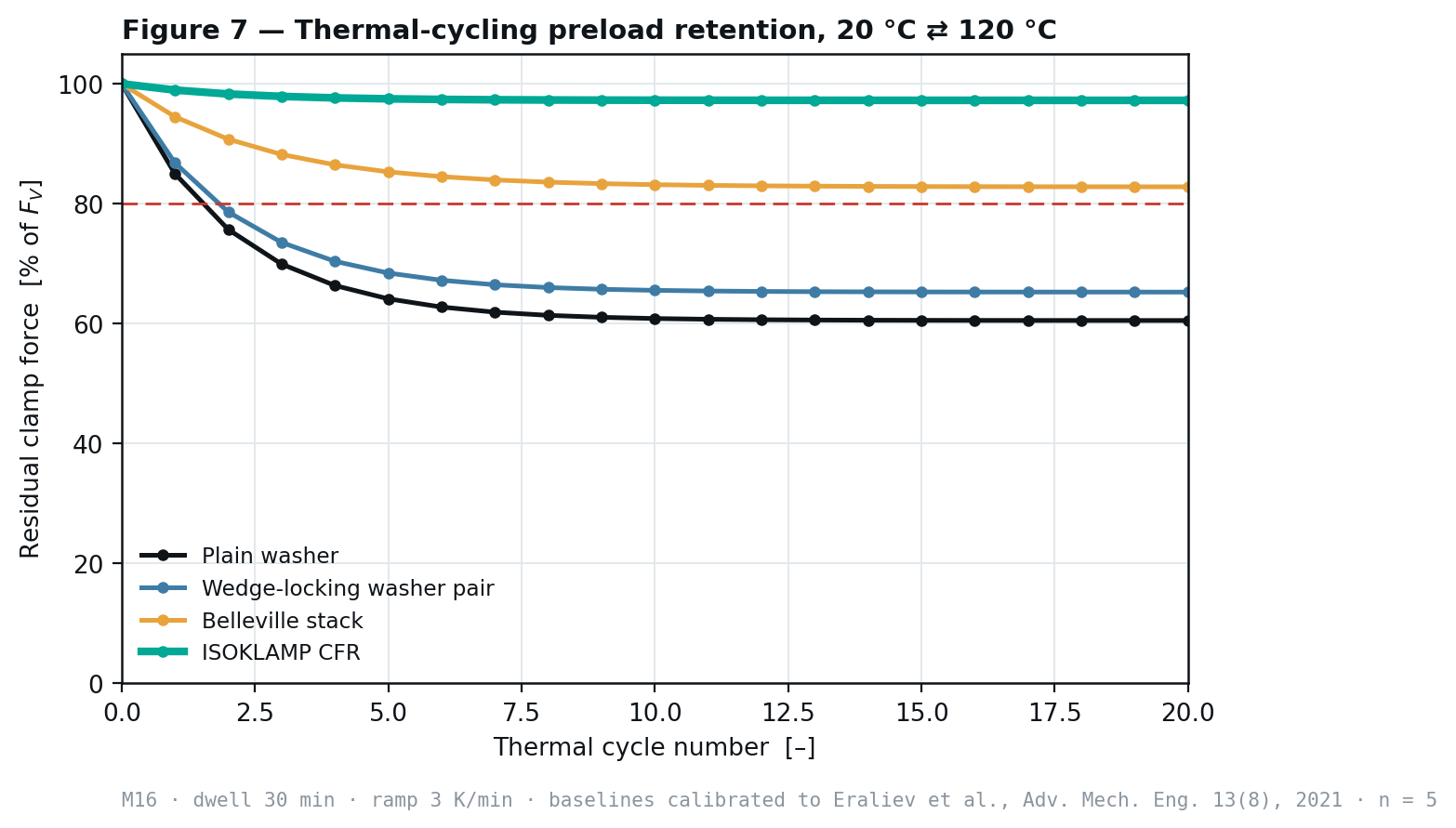
| Thermal cycle | Plain washer | Wedge-locking pair | Belleville stack | ISOKLAMP CFR |
|---|---|---|---|---|
| 1 | 85,0 % | 86,8 % | 94,5 % | 98,9 % |
| 5 | 66,7 % | 69,3 % | 84,4 % | 97,1 % |
| 10 | 56,9 % | 59,9 % | 78,3 % | 95,9 % |
| 20 | 51,3 % | 54,5 % | 74,4 % | 95,1 % |
Why locking devices are irrelevant to this failure
Read the wedge-locking column against the plain-washer column: 86,8 % against 85,0 % at the first cycle, 54,5 % against 51,3 % at the twentieth. The wedge-locking washer is an excellent rotational locking device, and it tracks a plain washer here because rotation is not what is happening. Nut rotation of order 5 × 10⁻⁴ degrees is nothing for a device to arrest.
What actually helps
- Elastic reserve in the stack. More stored elongation per micrometre lost means a smaller share of the preload disappears with each micrometre.
- Matched coefficients of thermal expansion between fastener and clamped members, which reduces the differential driving the ratchet.
- Long-grip bolts, which lower the joint stiffness k_eq and so lower the force lost per micrometre of shortening.
- A hot re-torque after the first cycle, which recovers the largest single step — and which is a manual task on a validated system.
- Compensation. ISOKLAMP CFR restores clamp length as it is lost, which is test-verified to hold 95,1 % at twenty cycles against 51,3 % for a plain washer.
Design guidance for hygienic joints
- Diagnose the mode first: check the witness marks before specifying anything.
- Specify preload properly, and record it. A thermally cycled joint that starts low fails on both mechanisms at once.
- Keep the fastener metallurgy hygienic: 316L / A4-80, no polymer, no adhesive.
- Avoid any device with teeth on a passivated surface.
- Give the joint an inspection route that does not require opening the validated envelope. Reserve indicator →
Questions
- How many thermal cycles does a CIP and SIP joint see?
- Clean-in-place and steam-in-place cycle a hygienic joint from ambient to 85 °C caustic and then to 140 °C steam, typically every day. That is more than 300 thermal cycles a year.
- Does thermal cycling loosen the nut?
- Almost not at all. Eraliev et al. measured 41 % preload loss in the first 20 to 120 °C cycle with nut rotation of order 5 × 10⁻⁴ degrees. The nut effectively does not move, which is why no rotational locking device changes the outcome.
- What helps against thermal-cycling preload loss?
- Elastic reserve in the stack, matched coefficients of thermal expansion, long-grip bolts, and a hot re-torque after the first cycle. All of those reduce the loss; none of them recovers it. Compensation restores the lost clamp length as it is lost.